

-
-
PROCESSESOur products range from induction melting furnaces ranging from 50kg to 15,000KG capacity, and our induction power suppliers range from 80KW to 12,000KW to meet all melting needs.
-
ADVANTAGEHTGP provides a systematic solution for scrap aluminum melting and casting.
-
EVENTS & NEWS
Conveyor Stability Analysis of Continuous Aluminum Ingot Casting Machine
Release time:
Oct 11,2023
source:
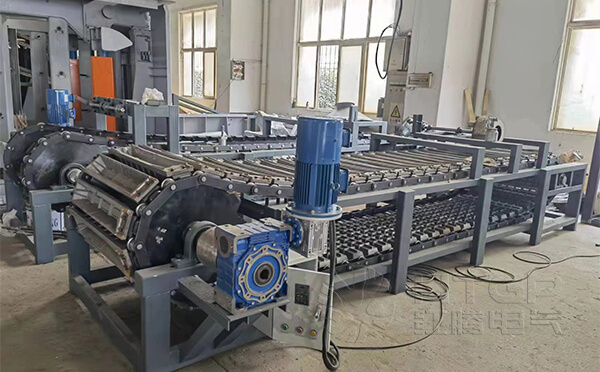
In the production process of aluminum ingots, the stability of the transmission system of the aluminum ingot casting production line is the key to ensuring the quality of aluminum ingots. Therefore, all aluminum ingot casting production line manufacturers are sparing no effort to carry out technological innovation to improve the stability of the transmission system. Today, Luoyang Hongteng discussed with everyone how to improve the stability of the transmission system of the aluminum ingot casting production line.
The most common aluminum ingot quality problem caused by the instability of the transmission system of the aluminum ingot casting production line is the appearance of ripples on the surface of the aluminum ingot. There is solidified aluminum on the track or aluminum ingots are stuck. These factors will cause the casting machine to vibrate and cause ripples on the surface of the unsolidified aluminum ingots. Slight ripples are inevitable and do not affect the quality of the ingot and are allowed. However, if the corrugation is more severe, it will affect the quality of the aluminum ingot, thus affecting the price of the aluminum ingot.
Common Surface Corrugations of Aluminum Ingots
Common surface corrugations of aluminum ingots include concentric circles, bubbles and grooves at both ends.
Concentric Water Ripples
The concentric water ripples are formed after the liquid aluminum enters the aluminum ingot mold through the distributor, cools and solidifies. It is a shape that centers on a certain point on the surface of the aluminum ingot and spreads in a corrugated shape to all sides.
Causes
When liquid aluminum is cast, it contains a small amount of waste residue. There are several main sources of waste residue:
Process residue
Liquid aluminum flows to the distributor through the chute. In order to prevent the liquid aluminum from adhering to the inner wall of the channel, talc powder is applied to the inner wall of the channel during production so that the liquid aluminum flows in the channel paved with talc powder. Part of the talc powder cannot be avoided. It enters the aluminum ingot mold cavity with the aluminum liquid.
Oxide slag accumulation
Since a large amount of oxidized slag often accumulates in the chute, it flows into the mold with the molten aluminum and solidifies before being removed in time, causing slag accumulation. The reasons for a large amount of oxide film slag deposits are:
1. The furnace aluminum liquid outlet is too small, causing the high-pressure aluminum liquid flow rate to be too large, which easily breaks through the oxide film wrapping the aluminum liquid flow;
2. The temperature of the aluminum liquid is too low, causing the liquid aluminum and slag to be unclearly separated;
3. The furnace outlet is irregular or there is slagging around it, causing the aluminum liquid to flow out in small streams, which increases the oxidation area of the aluminum liquid;
4. The liquid flow drop is too large and the oxide film is often broken;
In addition, the liquid aluminum is re-oxidized at high temperature in the holding furnace and the slag removal in the holding furnace is not clean, which is also one of the reasons for the generation of slag.
Bubble Water Ripples
Bubble-like water ripples are raised or floating block-like ripples formed on the surface of the aluminum ingot after the liquid aluminum is cooled and formed. After this kind of corrugation is formed, the surface of the aluminum ingot is uneven, and sometimes interlayers are formed when viewed in cross-section.
Causes
At the beginning of casting, the temperature of the mold is low, and the temperature rises rapidly after the liquid aluminum enters the mold. In actual production, the aluminum liquid is solidified by direct air cooling on the upper surface and indirect water cooling on other surfaces during casting. In this way, the aluminum is still in a semi-solidified state at a crystallization temperature of about 660C. Due to the temperature difference between water and aluminum Very large. The surface layer of the aluminum ingot solidifies due to water cooling. Due to the residual moisture in the mold, water vapor will inevitably be generated after high-temperature aluminum liquid is injected into the mold. During the solidification process of the aluminum liquid, the gas escapes from the interior and bubbles on the surface to form bubbly water ripples.
Grooved Corrugations at Both Ends
The groove-like corrugations at both ends are caused by the vibration of the mold during the cooling process of the liquid aluminum in the casting mold, forming corrugations on the surface of the formed aluminum ingot. The form is that deep groove-like corrugations are formed on the surface of the aluminum ingot. The closer to the middle of the ingot, the deeper of the corrugations.
Causes
Design link
Unstable operation caused by the polygon effect of the conveyor chain has an impact on the surface quality of the aluminum ingot; the rigidity of the casting machine frame can also have an impact on the generation of water ripples; the impact and vibration of the demoulding mechanism and the printer also have a certain impact on the water ripples Influence: The mold shape, release agent, and cooling rate all have a certain impact on water ripples.
Manufacturing and installation links
The manufacturing and installation accuracy of chains and sprocket guide rails have a certain impact on the vibration and operation of the casting machine, thereby affecting the "water ripples" on the surface of the aluminum ingot.
Usually these three types of ripples are intertwined and coexist. Among them, the third type of corrugation has the greatest impact on appearance quality.

Conveyor Stability Improvement Measures of Aluminum Ingot Casting Machine
Compared with the gear tooth profile, the sprocket tooth profile has great flexibility in the geometry of the tooth profile curve. A well-designed sprocket tooth profile must meet three requirements, namely meshing requirements, usage requirements, craftsmanship and precision. In order to meet these requirements, the design of the sprocket tooth profile must follow the following principles:
Ensure the chain enters and exits smoothly
According to the principle of relative motion, the meshing process of the chain link and the sprocket can be regarded as the previous segment of the meshed chain link has been correctly positioned. The meshed chain link will rotate with the former as the center and the chain pitch as the radius. Enter the sprocket. The chain hinges must not interfere with the gear teeth when meshing in and out.
Sufficient ability to accommodate chain pitch elongation
Since the chain will inevitably wear and stretch during work, the contact point with the wheel teeth will be moved outward. The working area of the sprocket tooth shape should ensure that the chain can still maintain normal contact with the wheel after the chain link is extended. . The longer the working section of the gear tooth profile is, the more chain pitch elongation can be accommodated, thereby delaying the occurrence of chain dropout during chain operation and extending the chain working life limited by wear.
Have a reasonable angle of action
The sprocket action angle is an important mechanical and geometric parameter that determines the sprocket tooth shape. The larger the action angle, there are more gear teeth in the surrounding tooth section to transmit the effective tension of the chain, but the meshing impact increases and tooth skipping is prone to occur.
The tooth profile curve is adapted to the working conditions of the chain drive
Adaptation of line and chain drives the working conditions of chain drives are very different, and the tooth profile curves should be adapted to their working conditions. For conveyor chains, the manufacturing accuracy of the speed sprocket is allowed to be reduced; because the sprocket is large, tooth slots with a large span pitch can be used to facilitate manufacturing.
Helps to engage and prevent the chain from falling due to chain jumping
Due to the polygonal effect of the chain drive, the chain does not move in a straight line on the tight side, but has periodic vibrations in both the longitudinal and transverse directions. In order to make full use of the working section of the gear teeth and prevent the chain from falling due to fluctuations, the chain must be a section of tooth top curve extends outside the working section of the tooth. The shape of the tooth top curve of the tooth profile should be conducive to the engagement and engagement of the chain hinge.
At Last
Luoyang Hongteng is a professional aluminum ingot casting production line manufacturer. After more than 20 years of painstaking research, Luoyang Hongteng has mastered the world's leading aluminum ingot continuous casting production line production technology and has provided high-quality products and services to dozens of aluminum casting manufacturers around the world.
We use optional cookies to improve your experience on our site, including through social media connections, and to serve personalized ads based on your online activity. If you refuse optional cookies, we will only use cookies that are necessary to provide you with the service. Privacy Statement
Leave your inquiry now, and get a systematic solution later.
We will contact you within one working day. Please pay attention to your email.

For any product inquiries, technical support, or service requests, contact us below:
WeChat/Whatsapp : 86-17538889778
Tel : 86-379-65188091
Address: No. H3, North Jingjin Road, Dongda Science and Technology Park, Luoxin Industrial Cluster, Luoyang, Henan, China