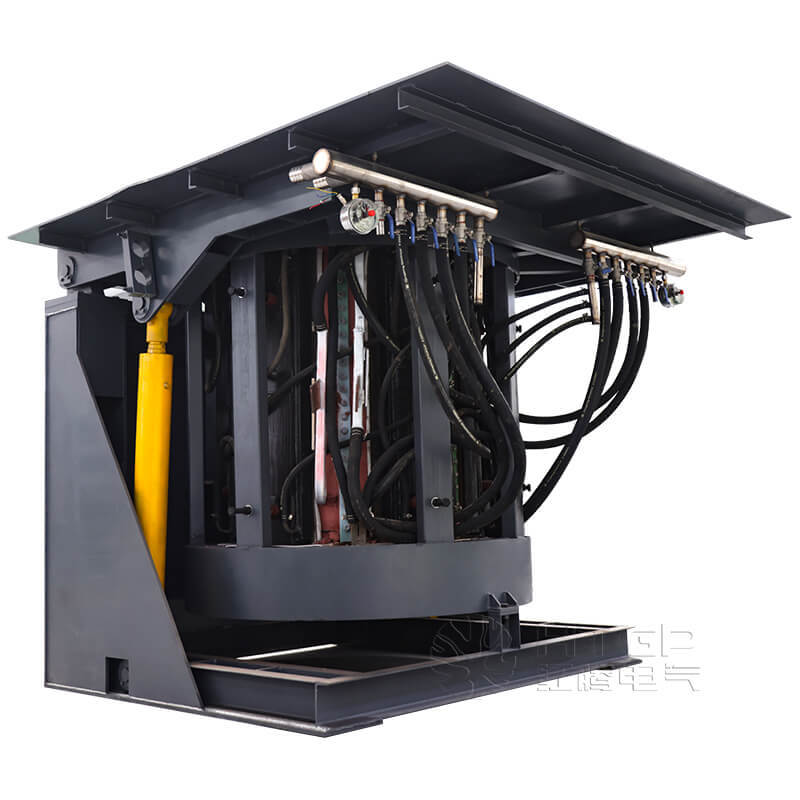
Our products range from induction melting furnaces ranging from 50kg to 15,000KG capacity, and our induction power suppliers range from 80KW to 12,000KW to meet all melting needs.
Induction heaters can melt metal. Induction heating uses the principle of electromagnetic induction to quickly and efficiently heat conductive materials such as metals.
The process involves generating an alternating electromagnetic field, which creates eddy currents within the metal. These eddy currents cause the metal to heat up due to the metal's electrical resistance.
When enough power is applied, the temperature can reach a level high enough to melt the metal. Induction heating is often used in industrial processes such as forging, welding, brazing, and metal melting due to its high precision, high efficiency, and ability to heat a specific area without contact.
Stirring helps to mix the alloys and continue the melting process. An induction melting furnacecan melt metals such as silver and gold, aluminum, copper, zinc, brass, and silicon.
An induction heater is a device that uses the principle of electromagnetic induction to achieve heating. It generates eddy currents inside the conductor through high-frequency current, thereby converting electrical energy into thermal energy to achieve heating of the conductor.
Induction heaters have the ability to heat quickly and can quickly heat metal workpieces to a high temperature state. This heating method is fast and efficient, and is suitable for various processes that require rapid heating, including metal smelting.
Induction heaters have a wide range of applications and can melt any ferrous or non-ferrous metal, including nuclear materials and various alloys. Whether in the industrial field or in the fields of medicine, dentistry, etc., induction heaters have a wide range of applications.
The power and model selection of induction heaters have a certain impact on the effect of smelting metal. Low-power induction heaters may not work well or take a long time, while high-power induction heaters are fully capable of smelting metal. Choosing the right power and model according to actual needs can meet the smelting requirements.
Induction heaters have the advantages of high efficiency, precise control, high safety and environmental protection. It can achieve fast and uniform heating effects, shorten smelting time and improve production efficiency.
By adjusting the frequency and amplitude of the high-frequency current, the heating power and temperature can be precisely controlled to meet the needs of different metal smelting.
The induction heater does not directly contact the heating medium, reducing the safety risk of operators contacting high-temperature objects. At the same time, it cools down quickly after the power supply is stopped, reducing the probability of accidents. In addition, the induction heater does not require fuel, does not produce harmful substances such as waste gas, wastewater and waste slag, and has good environmental protection.
In summary, the induction heater has the ability to melt metals, and has the advantages of high efficiency, precise control, high safety and environmental protection. Induction heaters have been widely used in application scenarios that require fast, uniform and efficient heating. Therefore, it can be said with certainty that induction heaters can melt metals.
We use optional cookies to improve your experience on our site, including through social media connections, and to serve personalized ads based on your online activity. If you refuse optional cookies, we will only use cookies that are necessary to provide you with the service. Privacy Statement
Leave your inquiry now, and get a systematic solution later.
We will contact you within one working day. Please pay attention to your email.